

Evidence
What the evidence is showing
CardMedic is used across more than 30 NHS hospitals and locations, as well as in US health systems – from ambulance handover, community nursing and outpatient clinics to labour wards, emergency departments and primary care.
Across NHS-funded evaluations, university-led studies and independent coverage, the evidence points in a consistent direction: more people supported, faster communication and a lower blended cost where CardMedic is used alongside professional interpreters.
Adoption and cost, one Trust
70% more patient interactions, for 9.6% more spend.
Stockport NHS Foundation Trust has the most complete cost and adoption data we hold: a full year of recorded activity set against the Trust’s own language-service spend. It shows what happens when a communication layer is added alongside an existing language-services contract rather than replacing it. The usage below is recorded activity. The financial figures are modelling, built on the Trust’s own language-service costs and its own CardMedic activity – not a national average, and not a saving we have banked on their behalf.
- 19,361 Patient card interactions Alongside 5,725 Live Translate conversations and 1,229 registered staff, across nursing, midwifery, medical, health visiting and AHP roles.
- £26 to under £4 Cost per interaction, through CardMedic Against the Trust’s existing £26 language-service average, with interpreter calls placed in the app counted inside that figure. Across their whole service, including everything still bought the traditional way, the blended average is around £16.
- £166,075 Modelled cost avoidance A local model built on this Trust’s own activity and contract data, not a universal saving. A shift of 15% away from face-to-face interpreting was modelled as enough to cover the annual licence. Method and denominators.
The pattern is not unique to Stockport
Stockport is the most fully costed example, not an outlier. Where we have run the same method on other organisations’ activity and contract data, cost per CardMedic interaction lands between £4 and £7, against existing language-service comparators of roughly £26.
We publish the range rather than the lowest figure in it. A single number from a single site is the easiest thing in this market to select and the least useful to you, and the spread is informative in its own right – it tracks how much of the service has moved across and the mix of conversations in each setting.
These are our own calculations on each organisation’s data rather than independent evaluations, and we will share the method and denominators behind any of them on request. Yours will be its own number, modelled from your data with the assumptions shown.
What the money actually buys
Two figures, measuring different things. Under £4 is what an interaction costs when it runs through CardMedic, interpreter calls placed in the app included. £16 is the average across the Trust’s entire language service once that activity sits in the model alongside everything still bought the traditional way.
The gap between them only closes in one direction. A blended average is weighted, so the more conversations run through the cheaper route, the closer the whole service moves towards it. That is arithmetic rather than a promise – but it is why this case strengthens with use instead of decaying after year one.
The average falls because conversations rise, not because interpreter calls fall. The 70% increase is in patient interactions. It is not a saving taken out of interpreting and moved to another budget line – access, quality and value moving in the same direction is the thing that was not previously purchasable.
Costs vary by organisation, contract and case mix. We model yours from your data, and show the assumptions.
Where the extra interactions came from
Not from displacing interpreters. From the everyday conversations that were not happening at all: introductions, pain, hydration, toileting, what happens next. Accessibility use was recorded separately – 1,013 Read Aloud, 231 BSL video views and 225 Easy Read.
Staff reported 15 to 30 minute waits when arranging a traditional interpreter call. Communication can begin while that call is arranged.
How the quality holds up
Health systems need communication support that is clinically governed, operationally usable and financially sustainable. CardMedic combines clinical authorship, linguistic expertise, technology-enabled assurance, structured governance and professional interpreter access in one repeatable system.
No one should have to choose between quality and scale – which is why the assurance behind these numbers is published in full, not summarised into a single accuracy claim.
How we assure it
A clinical baseline before translation, a six-stage assurance cycle, seven quality dimensions and version-controlled correction – applied in proportion to clinical risk.
Case studies
Eight services, two of them independently evaluated – maternity, neonatal intensive care, community, cancer care, an emergency department and a rural trauma center. Each states its setting, its size and whether the result was measured or reported.
- Independently evaluated Two years across three organisations Maternity, neonatal and community services in Nottingham and Nottinghamshire, evaluated by the ICB – including what went wrong.
- Organisation reported Six more services Epsom and St Helier, north east London, a London neonatal unit, The Christie, Leicester and Nor-Lea – described by the organisations themselves.
- Your organisation Build your own case A saving figure has to come from your data, not ours. This shows the assumptions and what to check locally.
Who feels the difference
Three audiences, three sets of findings. Start with whoever you have to convince.
Patients understand, and say so.
Independent evaluation found improvements in accessibility, understanding, confidence and overall experience – strongest for the people facing the biggest barriers.
- p<0.001 improvement in patient satisfaction Patient satisfaction improved on every measure in a US doctoral study. The p value is the chance of seeing a result this strong if CardMedic made no difference: here, below one in a thousand. Researchers conventionally accept a finding at one in twenty.
- 1,469 accessible-format views in one Trust Read Aloud, sign language and Easy Read, recorded in a single year at Stockport NHS Foundation Trust – patients using the format that works for them, not the one that happened to be available.
- Every format Easy Read, Read Aloud, sign language So the barrier changes the format, not the quality of care.
Staff reported better and faster communication in this evaluation.
In the independent urgent care evaluation, every member of staff surveyed said CardMedic improved communication with patients compared with what they used before.
- 100% said communication improved Surveyed urgent care staff, independent evaluation.
- 96% said it was faster than before Same evaluation, same cohort.
- 81% of maternity users rated it useful Independent maternity and neonatal evaluation.
A demonstrable reduction in the cost of communication.
The blended model – assured content, digital language support and professional interpreters in one place – puts the right method at the right time. That is where the savings come from.
- Lower cost per interaction Demonstrated in independent evaluation, from the same interpreting capacity.
- Fixed licence, whatever the demand Your costs do not climb with minutes used.
- Less waste printing, repeat appointments, travel Fewer avoidable contacts driven by communication failure. Net-zero relevant.
Patient satisfaction, measured before and after
A university doctoral study scored patient satisfaction across five dimensions during urgent care visits – before CardMedic, and with it. Every dimension improved, and the result was statistically significant.
Before With CardMedic Scored out of 5
-
Communication
Before: 2.13With CardMedic: 4.62 -
Relationship with the clinician
Before: 2.28With CardMedic: 4.68 -
Time spent with the clinician
Before: 1.77With CardMedic: 4.60 -
Overall satisfaction
Before: 2.25With CardMedic: 3.87 -
Perceived value of care
Before: 1.77With CardMedic: 3.73
Source: independent doctoral research at a US university, using pre-test and post-test patient satisfaction questionnaires during urgent care visits. Patient satisfaction improved on every dimension measured.
Reading p<0.001. Whenever something improves, some of it could be chance – a better week, a different mix of patients. The p value states how likely that is. Here, a result this strong would occur by chance less than once in a thousand times if CardMedic had made no difference. The conventional threshold for accepting a finding as real is one in twenty (p<0.05), so this sits well beyond it.
Maternity and neonatal care
Where communication failure does the most harm
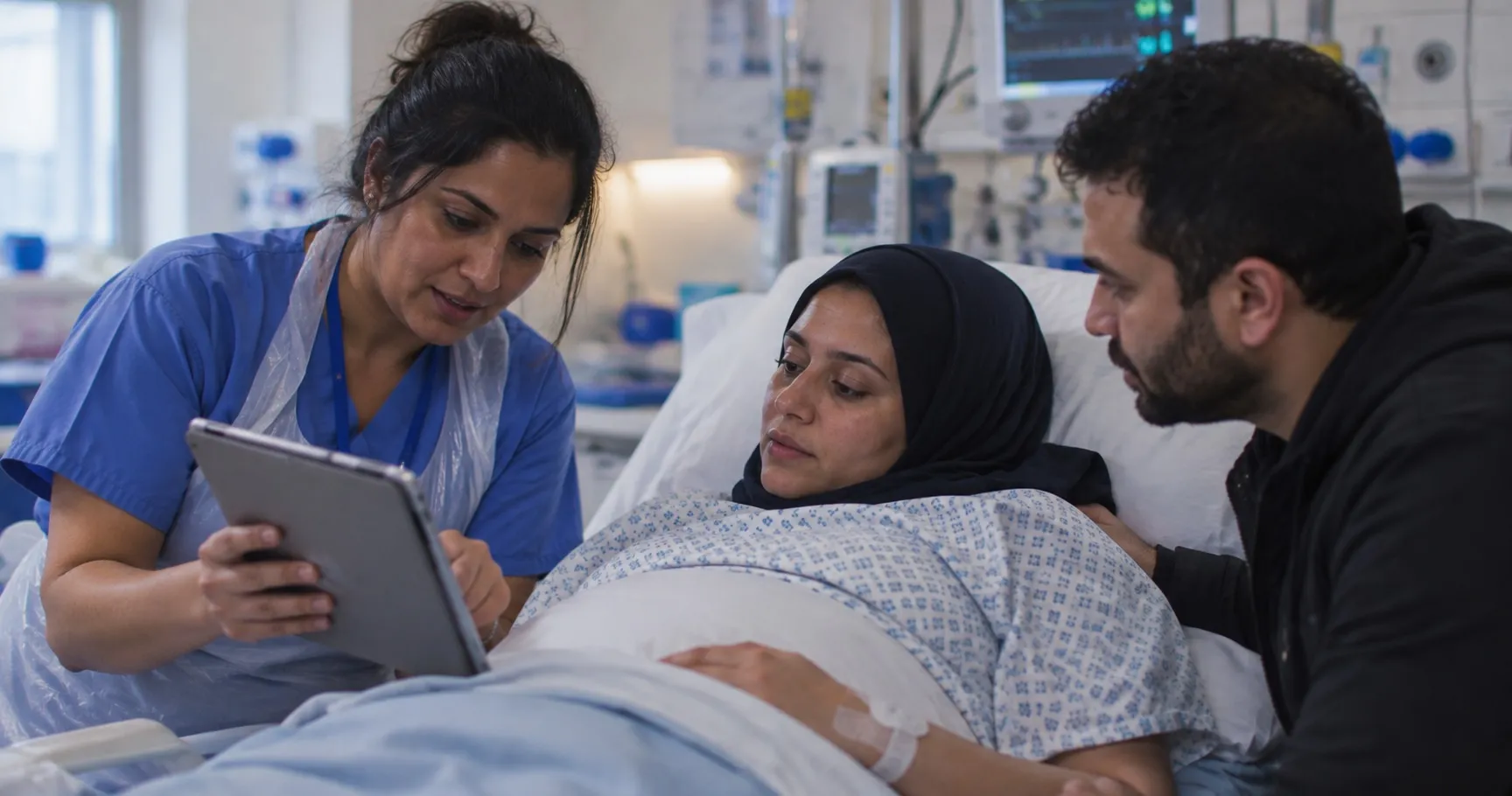
Nottingham University Hospitals NHS Trust evaluated CardMedic across maternity, neonatal and community services. Communication with women who have limited English proficiency is a recognised national priority in maternity care, and the Trust chose to act on it directly.
Their evaluation found strong, consistent evidence of enhanced safety, equity and efficiency. It is the kind of work a Trust does when it is serious about improvement, and the credit for it is theirs. Staff reported more confidence with women and families, clearer and more timely explanations, and faster access to multilingual information – with a professional interpreter one tap away inside the same workflow.
Reported by the Trust’s Senior Interpreting and Translation Services Innovation and Improvement Lead in The Linguist, the journal of the Chartered Institute of Linguists, and in the Trust’s own evaluation report.
- 88% of maternity staff aware of CardMedic
- 86% of those registered to use it
- 81% of users rated it useful
- 5,800 prepared card interactions
- 4,489 Live Translate activities
- 274 interpreter calls, 1,648 minutes
In their words
- Staff
“Total gamechanger. Migrant worker presented with atypical abdominal pain. Super quick and easy to use. Saved so much time, love it!”
Emergency medicine consultant - Patient
“Being able to understand straight away made a huge difference. I felt calmer, involved and able to give proper consent.”
Patient - Staff
“It gives us immediate access to multilingual content and our existing interpreter providers in one place. It saves time, reduces risk and improves patient experience across the Trust.”
Emergency department consultant - Recognition
“A truly innovative product that could change the future of the healthcare industry and be widely applied across the world.”
10 Downing Street - Clinical
“Clear messages. Brilliant communication tool for use with patients.”
Professor Donal O’Donohue, Royal College of Physicians - Press
“CardMedic flashcards ease patient fears in all scenarios, making it a gamechanger in healthcare.”
BBC
Where this fits in Core20PLUS5
NHS England’s Core20PLUS5 approach names the groups that experience the worst access and outcomes. Communication barriers run through several of them. We are not a health-inequalities programme and we do not claim to deliver one – but if you are reporting against this framework, here is the part we can evidence.
-
PLUS groups
Inclusion health groups, people with a learning disability, and people seeking asylum or newly arrived. All of them hit the same wall: information arrives in a language or format they cannot use.
-
Maternity
Four of our eight case studies are maternity or neonatal services, including two independent evaluations. It is where communication failure is best documented and where our evidence is strongest.
-
What we cannot claim
We have no evidence that we change mortality, diagnosis rates or any clinical outcome in these groups. Better communication supports care; it does not replace clinical assessment or treatment.
Other national priorities this work touches
- Reasonable adjustments. Communication support for vision, hearing, cognition, memory, mental health and neurodivergence, not language alone. Video and telephone interpreting cover some of these needs; they do not cover all of them.
- The Amos investigation and the 10 Point Plan. NHS England’s response to Baroness Amos’ independent investigation and Donna Ockenden’s review asks boards to collect and act on real-time experience data, with an explicit focus on the experiences of people from minority backgrounds. Experience data from women who could not be understood in the first place is missing data.
- Martha’s Rule. Rolling out across all maternity and neonatal services in 2026/27. An escalation right a patient or family cannot understand is not a right they can use, which makes language and format part of implementing it.
- Perinatal equity, and the Maternal Care Bundle. Both run to a 2026 and March 2027 timetable, and both depend on reaching the women whose outcomes the data says are worst.
These describe where communication is a precondition for a policy working. They are not claims that we deliver the policy, and naming them does not imply NHS England endorses this product.
Core20PLUS5 is an NHS England framework. Naming it describes where our work is relevant; it does not imply NHS England endorses this product.
Every figure, with its method attached
Healthcare has been sold enough unqualified numbers. Each claim below carries its scope, source, sample and definition, so your evidence team can check it rather than take our word for it.
How the routes were actually used
Recorded across the independent urgent and emergency care evaluation.
- Clinically governed content 6,199
- Live Translate 1,049
- Professional interpreter escalation 255
Professional interpreter escalation stayed open and was used throughout. That is the point of a blended model, not a number to drive down.
- Acute to community NHS care settings using CardMedic Emergency care, ambulance, inpatient, maternity, outpatient, community and primary care
- 50%+ Reduction in blended cost per interaction Independent NHS evaluation, with improved and faster communication maintained across the same period
- p<0.001 Improvement in patient satisfaction US doctoral study – a result this strong would occur by chance less than once in a thousand times